Getting Your Wichita Roof Ready for Storm Season
Storm season does not damage sound roofs - it finds the damage the calm months already did, and delivers hail, wind and driven rain to every weak point at once.
Read the Guide
Ice dams form when attic heat melts roof snow unevenly - water runs down to the frozen eave, freezes, and backs up under the shingles it was never meant to meet.
Problem: Ice dams form when attic heat melts roof snow unevenly - water runs down to the frozen eave, freezes, and backs up under the shingles it was never meant to meet.
Solution: The fix is thermal, not heroic: air-sealing and insulation to keep the roof deck cold, ventilation to clear what heat escapes, and sound eave details for the dams that still form.
When to call: Call when icicles line the eaves with stains appearing inside, when a ceiling leaks during a thaw, or when winter after winter repeats the same eave damage.
Kansas winters are not Minnesota winters, and Wichita homeowners are often told ice is not a local roof concern. Then a hard cold snap follows a snow, icicles fringe the eaves, and a ceiling stains during the thaw. Ice dams and freeze-thaw are real, if episodic, forces here - and they exploit the same houses every time: the ones whose attics leak heat onto the roof. This guide explains the mechanics and the actual fixes.
Hail is the signature threat. Sedgwick County sits in the part of the country where hailstones reach golf-ball size and larger with some regularity, and a single storm can decide the fate of every shingle roof in its path. Bruised, cracked and granule-stripped shingles may not leak the week after a storm - they fail across the following seasons, which is why hail here is an inspection question before it is a repair question.
Start with a heated attic losing warmth through the ceiling - around light fittings, hatches, duct runs and thin insulation. That heat warms the roof deck above freezing even on a cold day, and snow on the upper roof melts. The meltwater runs down the slope to the eave, where the roof overhangs unheated space and stays at air temperature - below freezing. The water freezes there, ridge by ridge, into a dam.
Behind the dam, later meltwater ponds. Shingles are designed to shed running water, not to sit submerged - ponded water works under tabs and laps, into the deck and the wall top below. The leak that results appears during thaws, indoors, at exterior walls: the ice dam's signature, and the reason it is so often mistaken for a simple roof leak and 'repaired' at the wrong address.
Even without dams, winter works Kansas roofs mechanically. Water that entered a split seal, a hairline crack or a lifted lap on a mild day expands as it freezes at night, wedging the opening wider; the next thaw admits more water. Across a winter of swings, small defects become entries - one reason spring inspections find damage that 'wasn't there' in fall.
Flat and low-slope roofs take their own version: ponded water freezing on the surface stresses seams with expansion, and thaw water tests every joint at the season's first warm rain. Metal roofs shed snow in slides that can tear at penetrations and gutters if unmanaged. Each system has a winter chapter; the common theme is water plus freezing plus an opening, in any order.
Ice dams are prevented at the ceiling plane, not at the eave. Air-sealing the attic floor's penetrations and bringing insulation to a proper, even depth keeps the deck cold, so snow melts uniformly with the weather instead of from below. Balanced ventilation - intake at the soffits, exhaust at the ridge - clears the heat that escapes anyway. A house with a cold roof does not grow dams, whatever the winter brings.
For roofs that have dammed, eave protection matters in parallel: waterproof underlayment membranes at the eaves (standard in any careful modern install) give ponded water a sealed surface to sit on while the thermal work is scheduled. Heat cables are the last resort locals sometimes ask about - they melt channels through ice but treat the symptom at an electricity bill, and they belong after the insulation conversation, not instead of it.
Kansas ice dams differ from northern ones in rhythm: not every winter, but in the winters that stack snow on a hard cold snap. That episodic pattern is exactly what makes them damaging here - houses are not built or maintained with dams in mind, insulation is uneven, and the first dam in five years finds every weakness the mild winters let accumulate.
The same rhythm hides the cause. A homeowner meets the problem as a random bad-luck leak rather than a repeatable thermal pattern, patches the ceiling, and meets it again at the next snow-plus-freeze. Naming the pattern - this eave, this attic, this heat leak - is most of the cure, because the fix list follows the map.
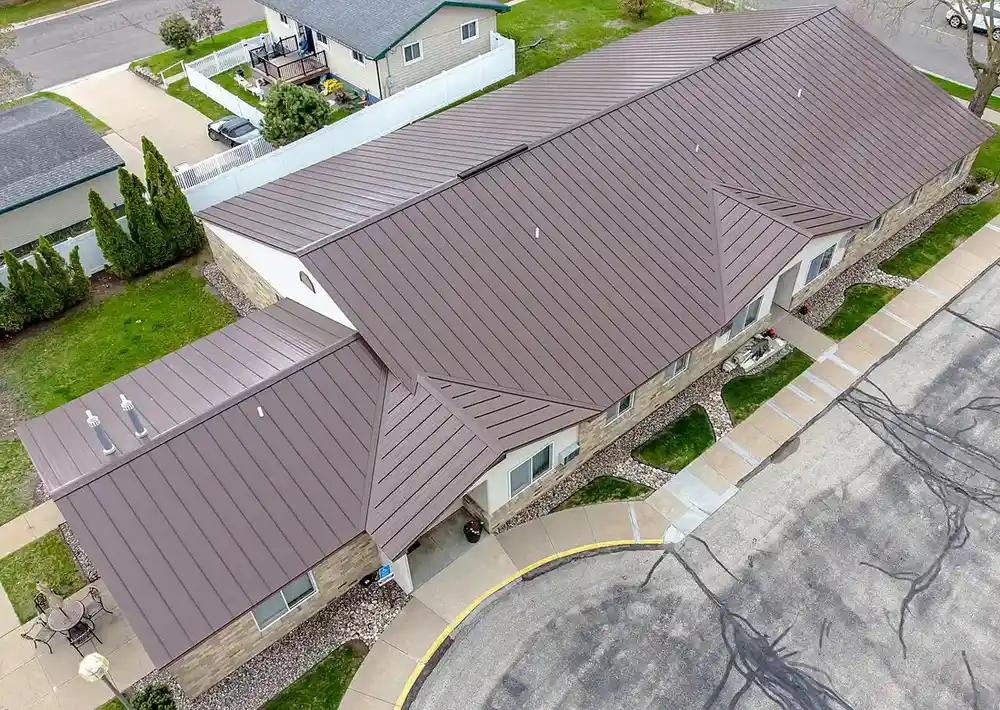
Smooth metal surfaces shed snow in sheets once sun or house heat loosens the bond, and a sliding slab carries real force: gutters tear, vent pipes bend, and anything below the eave takes the landing. Snow retention bars and guards exist precisely for this - they hold the pack to melt in place. On metal roofs in our winters, retention is not a northern affectation; it is the detail that decides whether a thaw is an event.
Ice at metal seams follows the same submersion rule as shingles: seams shed running water beautifully and resist standing water poorly. Eave ice that ponds meltwater against a seam line tests it in a way rain never does - one more reason the thermal fix, keeping melt patterns even, protects every roof type at once.
The useful way to think about a Wichita roof is as four systems sharing one address: the surface that takes the weather, the underlayment that actually waterproofs, the flashing and drainage that handle the details, and the deck beneath that holds it all up. Each ages at its own speed and fails in its own way - hail writes on the surface, wind works the fastening, water exploits the details, and time collects from all of them.
That is the service side of this guide's subject. When you are ready, the Roofing page carries the process, the coverage by neighborhood and the number to call.
Icicle lines, eave ice ridges and thaw-time stains at exterior walls mark the dam map.
Hatch, fittings, ducts and insulation depth - the sources are findable and fixable.
The permanent fix: keep the deck cold so the melt never starts unevenly.
Waterproof eave membrane specified in the scope - cheap insurance installed once.
After any snow on a cold snap, check ceilings along exterior walls during the thaw.
Log which eaves grow icicle lines - that is the dam map, winter by winter.
Keep soffit vents clear of insulation and storage; intake is half the system.
Never chip ice off the roof surface; the shingles come away with it.
An ice-dam assessment should map the dams to their heat sources: which ceiling penetrations leak warmth, where insulation thins, how the ventilation balances - with the eave protection state of the current roof reported alongside.
The resulting plan should separate the thermal work (sealing, insulation, ventilation) from any roof-side repairs, with each priced and sequenced on its own merits.
A professional ice-dam visit reads the house as a thermal system: attic air leaks found at hatches, fittings and chases; insulation depth and evenness measured; ventilation balance checked at soffit and ridge; then the roof's eave protection graded. The prescription follows the map - sealing and insulation first, roof-side work where the dams already did damage - and it is sequenced so the next cold snap grades the fix.
chipping ice, patching ceilings, cabling every eave.
Adding insulation without air-sealing first - warm air finds the new gaps just as well.
Blocking soffit vents with the new insulation and suffocating the ventilation.
Blaming the shingles for a heat problem and re-roofing the same attic.
Ice dams look like a roofing problem and behave like a heating one. Fix the heat path and the dams retire; patch the ceiling and they re-enlist at the next cold snap. The assessment that reads your attic honestly is the five-minute call that ends the cycle.
Storm season does not damage sound roofs - it finds the damage the calm months already did, and delivers hail, wind and driven rain to every weak point at once.
Read the GuideWater enters where it wants and shows where it pleases - the ceiling stain marks the end of the water's journey, not the entry, which can be rooms away uphill.
Read the GuideThey mean your attic is losing heat unevenly - a house problem acting on the roof. The roof itself may be sound. The dam's damage lands on eaves, deck edges and wall tops, so it deserves fixing, but the fix is thermal first, roofing second.
Because the dam needs meltwater behind it, and meltwater arrives when sun or a warm spell works the snowpack while the eave stays frozen. The delay fools many owners into blaming rain that fell days after the actual entry formed.
They manage symptoms expensively and belong low on the list. In our episodic winters, the sealing-and-insulation fix usually costs comparably over a few seasons and removes the cause - plus it pays back in summer cooling. Cables make sense mainly where the thermal fix is impractical.
Metal sheds much of the problem, but sliding snow loads and ice at eaves and transitions still stress details, and meltwater ponded behind ice can test seams not designed for submersion. Snow retention and sound eave details are the metal roof's winter answers.
One call connects you with a roofing professional serving Wichita and the surrounding communities - inspection, repair, replacement and upkeep.
📞 Call Now